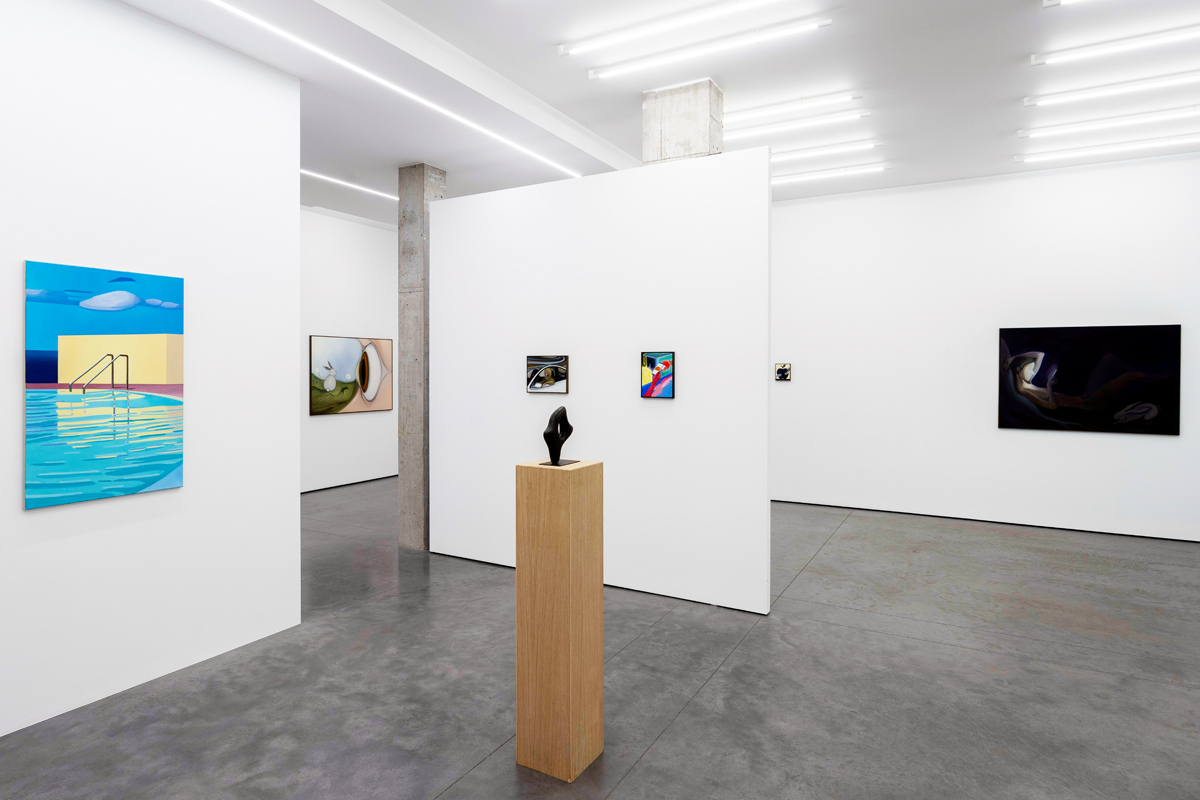


Whitehouse Gallery unites three young female artists Ara Méndez Murillo (b. 1997, Córdoba, ES), Mina Enowaki (b. 1998, Annecy, FR) and Nancy Moreno (b. 1990, Montauban, FR) in a group exhibition. Although all three graduated from La Cambre in Brussels, their artistic practices diverge in striking and intriguing ways, rendering the dialogue between the works all the more dynamic.
Each artist is distinctly marked by her background, which resonates through both their artistic choices and working methods. Personal experiences and interests form the blueprints for their practices, shaping the recurring themes, media and styles. Even the more ‘daily affairs’ of their lives – like favorite colors, poems, or vacation spots – are important puzzle pieces for the narratives in their works, deepening both their individuality and personal meaning. The selected bodies of work thus offer a glimpse into the artistic stages the three artists currently inhabit. They reflect ongoing processes of negotiation, doubt, confidence, experimentation, and success – elements inherent to their artistic practice and to an artist’s life tout court.
Ara Méndez Murillo
Ara Méndez Murillo extracts meaning and symbolism from spontaneous sceneries she encounters, which she conveys through bright colours, special light/ shadow effects, smart compositions, and playfully assembled objects, figures and landscapes. While she was formally trained in painting during her bachelor in Fine Arts at the University of Seville (Spain), her artistic direction – both technically and narratively – crystallised during her years in Brussels. At La Cambre, her visual language expanded in scale and nuance. Represented by Whitehouse Gallery, Murillo showcased her works in previous exhibitions (‘A light’s narrative’, 2022; ‘The other team’, 2024) and art fairs.
Colour plays an essential role in her paintings, both during the creation process, as in the end result. “I create volume and distance using colours and light; they bring an image to life,” she notes, drawing viewers instantly into scenes where sun-soaked Spain appears vibrant and luminous, and even dreary Brussels is transformed into saturated sceneries. Colour and composition are her trusty tools to open up the hidden layers of life’s day-to-day activities, landscapes and routines – revealing unexpected beauty, symmetry, humor, emotion and meaning.
Murillo’s paintings grow from anecdotal snapshots she makes along the ongoing course of her day-to-day life: sunsets framed by her window, people absorbed in an activity, or a striking cityscape she encounters while travelling. Her works often suggest suspended movement, freezing moments that leave viewers wondering what has just occurred or what is about to unfold moments later. Anticipation and suspense – but also curiosity – are emotions she evokes through this suspended temporality. She invites us briefly into her vivid worlds, where everyday observations are elevated into layered, colour-driven scenes, vibrating with underlying symbolism and meaning.
Mina Enowaki
Mina Enowaki grew up between the mountains of the French Alps and spent her summers in Osaka (Japan) – a dual heritage that forms the foundation of her artistic practice. Her work draws from these contrasting environments: French landscapes and neighbourhoods on the one hand, Japanese folklore and beliefs on the other. Photography, her first artistic love and the focus of her studies in Lausanne (Switzerland), remains the conceptual base of her artistic practice, which is multidisciplinary at heart. Since then, she has expanded her skills through classical painting training at La Cambre in Brussels and through residencies at Fondation Moonens and Fondation CAB, where sculpture, mixed media and textile became central to her evolving visual language.
The bronze sculptures on display are the culmination of this multidisciplinary trajectory. They originated from photographic visits to a Japanese garden in early 2025, where Enowaki began developing a visual language that plays with scale, perspective and composition. Initially imagined through collage and mixed media, and collected in a book published with S U N (New York), these fictional forms were later materialised as clay models, and ultimately cast in monumental bronze. They reveal how Enowaki’s practice continuously shifts between inspiration, documentation, invention, and material reality. Inspired by artists Barbara Hepworth, Henry Moore and Isamu Noguchi, Enowaki creates stylised, smooth and dynamic figures. They seem to defy gravity as their shapes are captured in mid-movement. Despite the static solidity of bronze, the sculptures appear almost fluid – ready to shapeshift into another form or drift quietly into another garden. Reflecting this multidisciplinary trajectory even more, Enowaki chose to accompany the bronzes with miniature textile screens depicting the shaped, inspired by traditional Japanese architecture.
The link of the bronzes to their earlier, garden-bound iterations remains palpable. Drawing on Japanese beliefs that natural materials possess spirit and agency, Enowaki imbues her sculptures with roles like ‘Gardener’, ‘Sungazer’, ‘Guardian’ or ‘Voyager’ – inviting viewers to reconsider natural objects not as passive matter, but as active participants in our ecosystems and lifeworlds.
Nancy Moreno
Nancy Moreno’s paintings captivate viewers through both technique and subject matter. She graduated from La Cambre in 2014, with a specialisation in drawing. Not being classically trained as a painter, Moreno’s method grew out of years of self-taught practice, resulting in autodidactical skills perfected to her own rhythm and style. Represented by Whitehouse Gallery – where she exhibited previous bodies of work in 2019 (‘Déréalisation’) and 2023 (‘Buzz’) – Moreno now continues to expand her distinctive visual language.
Mixing resin with oil paints, Moreno builds up her paintings through multiple translucent layers of paint. Each layer requires roughly two weeks to dry before another can be added, stretching the process over long periods of time. Echoing the optical logic of Old Masters like Jan van Eyck, this method produces an illusion of depth and perspective – giving the works their characteristic soft and slightly blurred appearance. Through this careful handling of material, her paintings seem to glow from within – as if lit by an unseen source behind the image.
Moreno draws inspiration from lived experiences and scenes, as well as from imagination and dream-like visions. The works hold a ‘flux of life,’ or the capacity of a painting to not merely capture a moment – as a photograph might – but to gather and suspend visual memories, mediatic streams and internal visions. While a photo freezes a moment taken from reality, Moreno’s paintings extend it, inviting us to look beyond the layers of paint and add a layer of interpretation of our own. Other narratives derive completely from Moreno’s inner self: she paints surreal and bizarre images that stem from a deep fascination for certain themes and concepts. The motif of the bunny, for instance, is drawn from Moreno’s symbolic language, personifying fear and symbolising unknown worlds on the one hand, and appearing cute and endearing on the other. This process from idea to painting unfolds between instinct and meticulous technique, ultimately materialised in these layered, luminous images.
Astrid Van Baelen
