

'Add Time'
The unreliable promise I CALL YOU LATER solidifies into nylon, while long-gone graffiti from New York and Amsterdam is resurrected in a tapestry. Sung and spoken words are caught in ribbons of thread and fragile assemblages of fabric are thickened in wax. Even the celestial infinity of the sky is given a face and hands as it’s anthropomorphised into the goddess Nut, who bends over the Earth as she scrolls endlessly on her incongruent phone.
These works try to grab and hold what might otherwise slip through our metaphoric fingers. They plead: BE STILL, BE MADE OF SOMETHING. Wax, fabric, bronze, clay, tin, all play a part in giving weight to fleeting remarks, GPS, and scarce blocks of empty time. There is certainly an anxious appraisal unfolding, of digital life and the incursion of screens into our personal domains, but it is less dismissive than curious. Stéphanie doesn’t destroy the cloud(s) but arranges it in different forms: she weaves it a face, casts it, asks what material might hold it down. She moves the online agenda off-screen but doesn’t delete it; its familiar virtual grid materialises as a paravent, a room divide, this temporary architecture assigning it an authoritative substance. She takes the loaded buttons that we click daily – ADD TIME, ADD LOCATION – and articulates them as singular and static in thread. Through these gestures, the show rewires its anxiety into an exploratory material study.
Whilst in search of texture and form, the works refrain from a nostalgic or Luddite approach. They are not straightforwardly looking backward. They are not saying HANDIWORK OR NOTHING. Two tapestries inspired by the Sibyls make use of newer materials like Lurex and recycled PET and are produced by computer-controlled Jacquard weaving. Like a Google Calendar, a Jacquard loom is an efficiency machine. It speeds up, optimises, organises. Both are tools against loose ends, tightening together days and minutes, strands and threads, into a neat, graphic whole. The Sibyls also remind us the show is looking forward, and thus exhibits a kind of hope; if there were no future, there would be no Sibyls. These foretellers would bear no prophecies; we could throw our calendars in the bin, call in sick for work, and run riot without consequence.
Stéphanie’s research looks for a soulful mechanics, an attempt to divert the material world from becoming frictionless and too smooth. But this direction itself may come from a search for ease: it is easier to address the supposed frictionlessness of technocapitalism than it is to parse the unrealistic frictionlessness we are expected to practice as people, living, compromising, and caring together. Our meeting in the studio is organised around daycare opening hours, where Stéphanie will cycle to collect her daughter, Lola. The production hours of her latest tapestry are strictly allocated across six days, split between 10AM and 5PM. Dinner times, sleep routines, research hours, the making of this exhibition; life and work are administered down to the minute. It may be said that ideas cannot be timed, but what is said louder is this: You must parent (care) as though you don’t work, and work as though you don’t parent (care). The directive is to be sharply boundaried, operating in clear, frictionless segments: an image of the calendar itself.
Woven into the corner of a tapestry is Ananke, Greek goddess of necessity and constraints. I first thought I’d write that Ananke is represented in the exhibition by the Google Calendar, and about how as long as life is over-administered, we cannot find other, better futures. But I realise this is a misreading. Ananke cannot be the Google Calendar, because such strict administration of time is so often an obstacle to necessity. By forcing organic life into unrealistic shapes, what is necessary becomes increasingly difficult to execute. I CALL YOU LATER becomes another task on another list. We simply cannot find the time. The calendar is maybe even an enemy of Ananke. What’s more, its constraints are usually in service of someone else – a boss, a landlord, the patriarchal organisation of western society. If we understand Ananke’s force as necessity, it surely must be in service of life itself. Necessity is after all only the demands of life on planet Earth. In these works, Ananke is not the Google Calendar, Ananke is Lola.
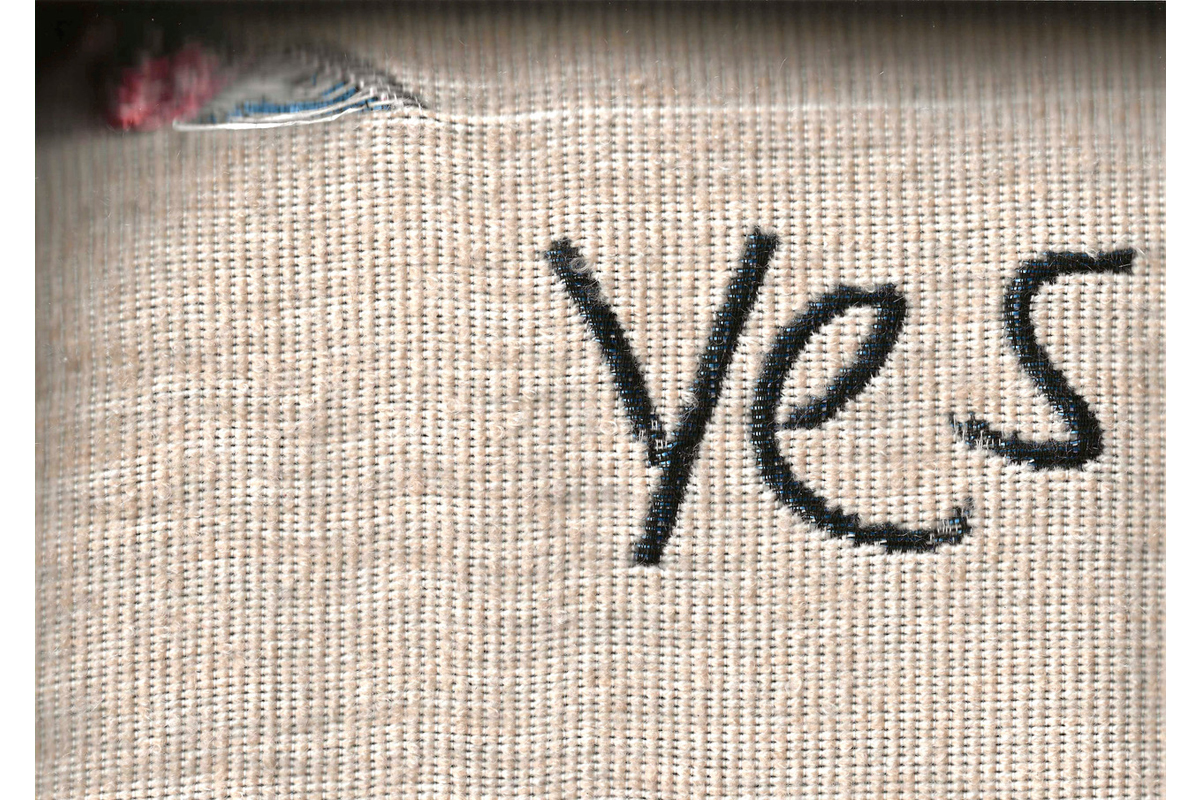
Lola, like Ananke, dictates circumstance. The YES of her first spoken words stretches across a tapestry with crystalline certainty. Her thick pencil marks traverse the neat columns of the Google Calendar with assuredness and force: both in image and reality, she is too volatile and vital to be honed into a boundary. With no regard for the organising principles that she finds herself disrupting, Lola’s force is fundamental. A child, a dependent, a body, an illness, a friend, a love: these masses of friction that make up our lives are not disruptions of necessity but are its very essence. So why is it these masses of friction that we often believe we don’t have time for? In making material the evidence of labour, craft, planning, family, and social life, these works remind us that our expectations of a frictionless, project-managed existence are absurd. I think Stéphanie is searching not only for a soulful mechanics of technology, but of social life, in which true necessities are not obstacles but priorities, in all their vital unpredictability.
Text by Harriet Foyster
