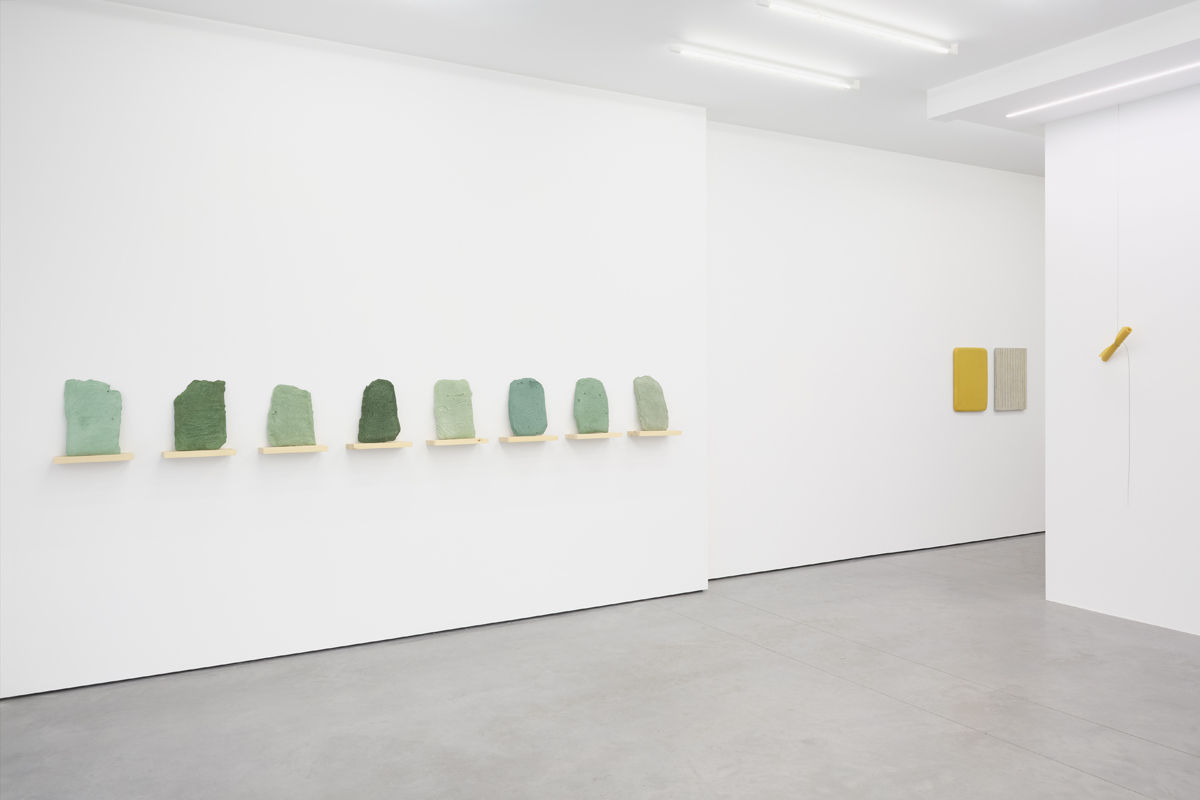




With ‘Manifeste’, Caroline Le Méhauté draws our attention to the relationships we maintain with living environments at the heart of a highly industrialised world. What emerges from the selection of works is the juxtaposition of different material regimes: earth and wax, derived from living organisms and possessing organic, ever-changing qualities, stand alongside concrete and metal, associated with construction and technical mastery. The works explore how these materials meet, constrain one another or transform upon contact, revealing a constant search for balance amidst the folds of materials in motion.
Furthermore, the earth used in this exhibition carries profound symbolic significance, as it originates from the UNESCO World Heritage site, ‘the Cradle of Humankind ‘ (South Africa), where Caroline Le Méhauté worked during a residency. By taking a tiny amount of this earth, the artist makes a gesture that is above all symbolic: that of moving a fragment of the territory where the oldest hominid was discovered, and of questioning, through this material, what it means – and how it feels – to stand before the land of our origins.
Matter in Motion
In keeping with her previous explorations, Caroline Le Méhauté respects the fact that matter never obeys completely: it resists, it warps; one must learn to understand it in order to engage with it. It is within this space of negotiation that her work is situated: an in-between that eludes the strict categories of sculpture or painting, developing as a multidimensional approach to matter and its relationships. For example, in the work resembling a wax frame – borrowing the technical tools of beekeepers – using embossed wax sheets intended to guide the construction of honeycomb cells, the artist creates a layered and irregular structure. The work reveals the architecture of the hive and invites the visitor to look at what usually remains invisible: the honeycombs, still empty, awaiting honey. By delicately tearing the sheets of wax, warming each piece in her hands and layering them, the artist creates a dialogue between the domesticated dimension of the rectangular frame imposed by beekeeping and a wilder, more organic dimension that the material regains through its deformations. Suspended and presented head-on, the piece extends an approach the artist has previously employed: taking a material and placing it before the visitor so that they may look at it. So that they may truly look at it.
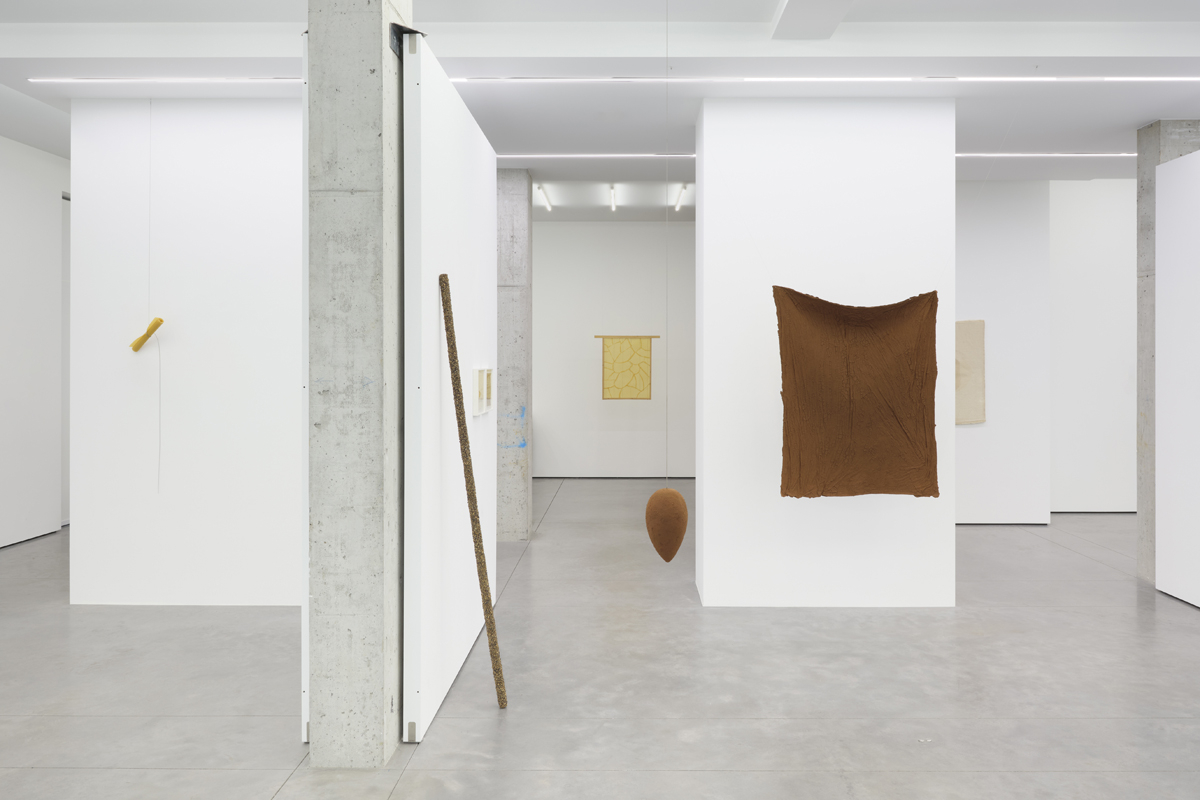
Another suspended work… ‘L’Indocile’. It consists of a large rectangle of fabric impregnated with earth, displayed at the heart of the gallery. Here, the origin of the material is fundamental and highly symbolic: the earth comes from ‘the Cradle of Humankind’. The artist’s intention is to create a face-to-face encounter between the visitor and this earth from a region where the first hominids appeared.
The impression of the fabric being torn apart, the cracks inherent in the life of the earth material, and its rust-coloured hue all contribute to the piece’s powerful presence. In a way, the work leads us to question, with humility, the relative scale of our existence on the scale of world history and human history.
Balance and forces in tension
In her work, Caroline Le Méhauté explores the concepts of balance and precision as a means of examining the relationships between the forces at play. This exploration is particularly evident in the piece reminiscent of a plumb line: a metal cable connected to a solid, ogival-shaped clay form. Together, they form a piece in which metal and clay are in tension as they seek their point of equilibrium—an equilibrium that is never static, but is constantly replayed through movement and the ongoing adjustment between the forces at play. Through the figure of the plumb line, a tool used to test verticality and accuracy, the work raises the question of the right position between humans and other forms of life. The artist has chosen to preserve the raw texture of the clay, far removed from any smooth object: a fragment of a preserved world that retains its visible origins.
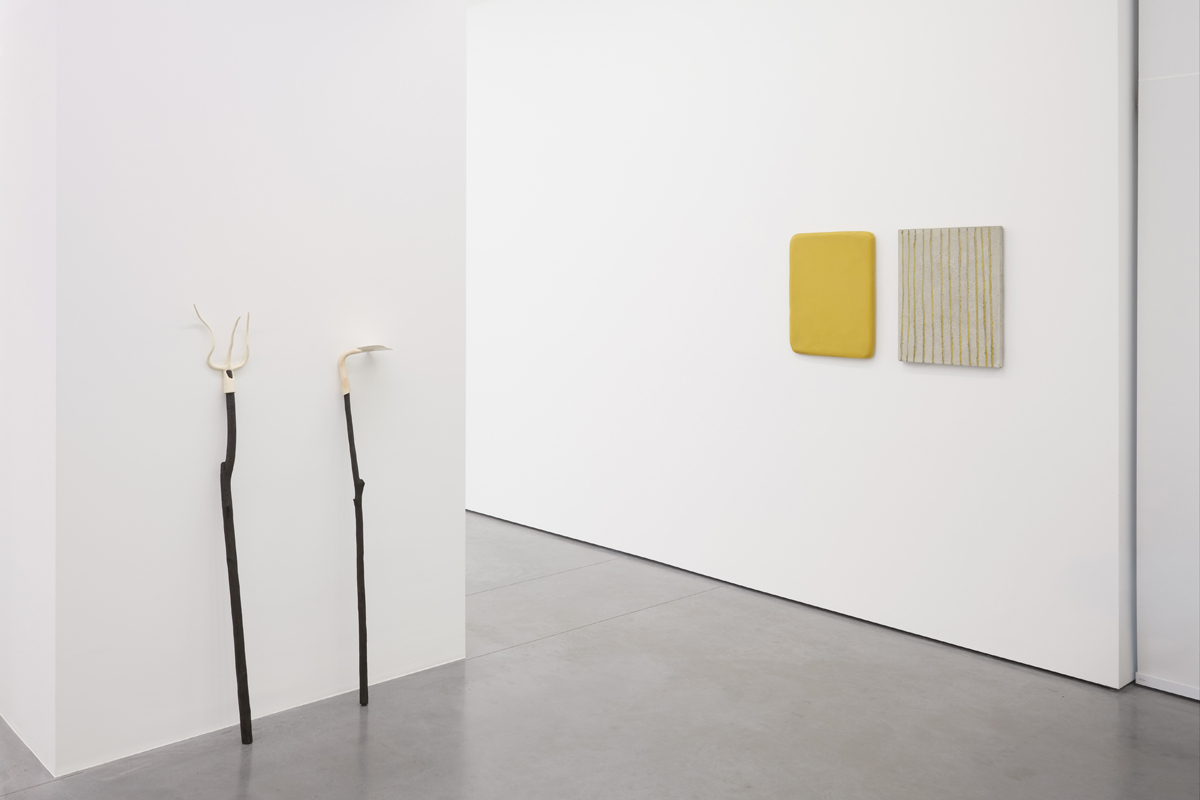
The works in the exhibition explore humanity’s place on Earth today and the way in which its presence is embedded in the environments it inhabits. This reflection extends into other works featuring gestures that appear, on the surface, to be of great simplicity, such as these repeated earthy imprints on paper, which question the disappearance of the material as much as that of the gesture and the person who made it. Or the ‘ready-made’ – the artist’s first – consisting of two stakes and a wire holding fragments of the soil in which they were in turn planted and dug up, reminiscent of construction site markings as signs of claiming a piece of territory. Finally, there is this piece entitled ‘kompromat’, which takes the form of a wax parchment, like a message that bees and pollinators might send to humans. The title deliberately borrows a political term referring to compromising information: in this work, ‘nature’ seems to hold the silent evidence of what human activities are doing to the environment on which they depend.
Manifeste
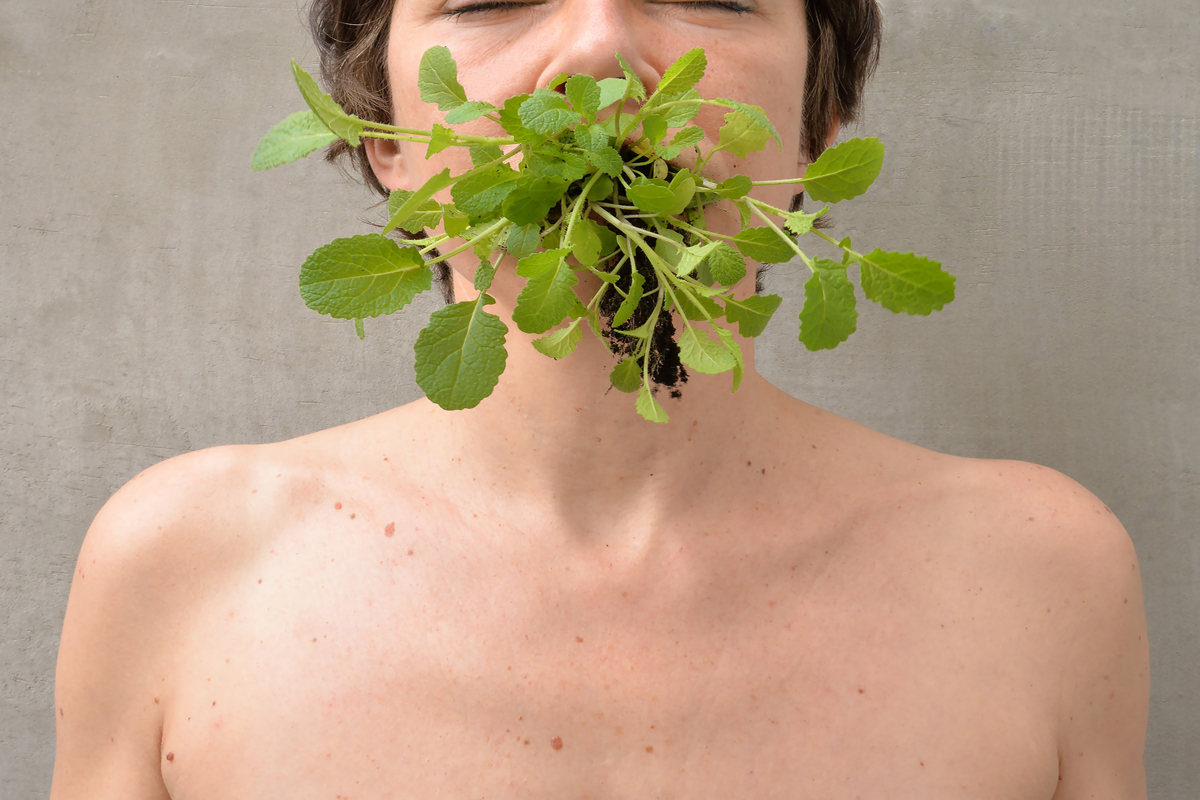
The unique imprint at the heart of a frame – that of the artist’s pointing index finger – resonates with these plaster panels on which Caroline Le Méhauté has inscribed excerpts from the 1972 Meadows Report, the first report to warn of the limits to growth, a warning that went unheeded. These fragments of thought inscribed on a material as brittle as plaster invite us to consider the fragility of a message despite its importance and necessity. Or take this self-portrait of the artist, her mouth full of a clod of earth dotted with shoots of brown mustard – a type of brown mustard used in phytoremediation, a technique aimed at soil decontamination; a reference to [Tellus Project], an ambitious project led by the artist, dedicated to soil care and taking various forms such as installations, sculptural works, participatory workshops, lectures, etc. – demonstrates the artist’s commitment to their work. We also encounter a stick and a bow covered in seeds: honey-bearing seeds on the stick, brown mustard seeds on the bow. These two works symbolise the work of dispersal and soil decontamination/restoration that Caroline Le Méhauté undertakes through workshops and sessions.
The title of the exhibition, ‘Manifeste,’ naturally stems from the socially conscious message that Caroline Le Méhauté places at the heart of the works she presents, inviting visitors to reflect on their own stance towards the world.
Claire CORNIQUET
